How I Excelled This Year:
Honors Physics
To excel in anything in life is to consistently improve and maintain a steady work ethic throughout a process or project. Science Fair was a long process that involved major brain storming, planning, precise and detailed writing, working together and presentation skills. After my partner and I came to the consensus of Eco-Architecture as our topic, we started to write our research question, hypothesis and also conduct research. We decided that we would conduct an experiment that would test the effect of light on different colored siding to see which would be a more efficient color. We then collected data and learned how to organize the information that made the results visually easier to understand. The next part of the process was writing a report which included an abstract (summary), background (research), hypothesis, materials, procedure, data analysis, and conclusion. This took multiple drafts before it was perfected for the science fair. Finally, we made a trifold that emphasized the most important parts of the process to aid our presentation at the school science fair before judges from various professions. Throughout the process, my partner Kenzie and I, excelled as a team through communication, organization and time management. Our first draft which included the entire process of our experiment including an abstract, background, hypothesis, materials, procedure, data analysis, and conclusion took a lot of time and focus to complete and incorporate all of the requirements listed. We would meet and write together, critiquing our process until we thoroughly described our experiment in an understandable manner. The hardest part to excel in was writing the data analysis which contained averaged percent differences of growth in the temperature of each color siding throughout the trials. Through this hard and challenging writing process, we received an 85% on our first draft with positive comments such as “Very good draft”. The main changes that we were advised to make were minor or ideas on how to go above and beyond in our connections such as climate change. After we revised the report with the feedback given, our score was raised to a 98%. As a team, we received one of the highest grades in our class, which was only achieved through time management, communication and organization. Another aspect that requires a lot of practice and collaboration between Kenzie and I was our presentation. One tool that really helped us to excel at this was notecards that were detailed and numbered to guide us though the presentation. We also had to be active listeners during the presentation so that we knew when it was our turn to speak. The presentation was a great opportunity to share our findings in our experiment, which were darker color siding absorbs more heat and therefore should be used in colder climates, and to relate our ideas to similar fields. In the end, we received an average, 94% on the judging card which qualified us for district science fair where we won two environmental awards. This challenging process opened up opportunities to try new topics as well as maintaining successfulness along the way. In 10th grade, I hope to be challenged Science Fair more than I have this year so that I will be able to push myself to excel in more difficult qualities.
 |
|---|
 |
 |
 |
 |
 |
 |
 |
|---|
 |
 |
 |
 |
 |
 |
 |
 |
 |
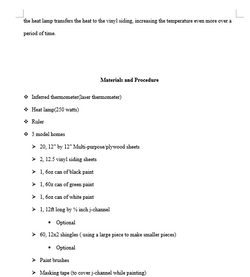
These pictures show my first draft of my report and the feedback that I received form my teacher, Mr. Bottelier.
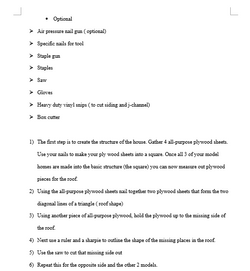
These pictures show my final report and the score that I recieved according to the rubric.