Modeling
Science
In this learning process, we investigated as a class, how and why our bodies use food. We started with cells and organisms and later moved into the digestive, circulatory, and respiratory systems, which is what I will focus on. In this unit we learned how to model what happens inside of our bodies. This process this helped me to grow in my ability to make my models that displayed content of things that I could not see. Modeling was the key to learning the content in this unit. It really helped me to visualize what was happening.
To get to this point we had to learn how to make a well-constructed model. One thing that helped was the acrostic, MEGA (M-Mechanistic (how and why), E-Evidence, G-Generality, A-Audience). To meet these requirements, we started to make models as a class. We eventually we moved on to making models in small groups and then individually. One of the main things that helped us to achieve the MEGA standards was feedback or critique. We would sometimes make a model on our own and then have a class critique to get feedback on our model.
One of the models that my group and I constructed was made in our ISN (pg.52). This model was representing how the digestive and circulatory systems are connected. Before I made my own model of this and after a class critique of it, I learned that I could use less words and more symbols/pictures. I used this feedback when our group made a second draft of this model. In the 2nd draft there were fewer words and more colors to help to represent pictures. We also added a key to organize the components of the model without cluttering it with labels.
This model explained that food gets absorbed into the villi in the small intestine (small hair-like structures that absorb nutrients from food). When nutrients get absorbed into the villi they enter the cells that line the villi. After this, the food moves into the capillaries (small blood vessels). The capillaries lead to larger blood vessels that spreads the nutrients throughout the body.
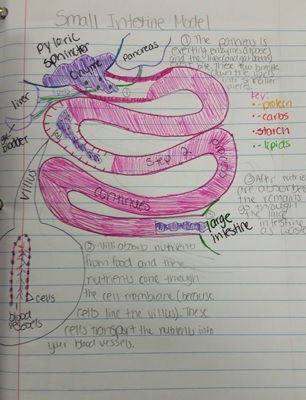
We also got critique from our partners at our tables on models. We would individually make a model and then switch with our partner and get feedback. We used our feedback to revise and make a 2nd draft. Two models that I got critique on summarized the digestive system in the stomach and small intestine. I learned through these critiques that I could use color to emphasize important aspects of the model. I did this by having a color for each feature in the model. This helped me to learn to improve my model making skills.
The stomach model explains how food gets chemically broken down (it cannot be changed back after the reaction) using stomach acid. It is also mechanically broken down when the stomach expands and compresses. This model also explains why the food is broken down, to be small enough to fit into the small intestine. This leads to the small intestine model which explains how fats are chemically broken down and how nutrients are absorbed. The fats get chemically broken down by enzymes (lipase) and bile from the pancreas and liver. These are acids that break down fats that are not water soluble. Since fat is not water soluble it needs these special acids. After all of the food is broken down the food moves through the small intestine and the nutrients get absorbed by the villi that line the walls of the small intestine. What is left is waste which is sent to the large intestine.
Another endeavor that helped me to grow in modeling is the product that we did at the end of the unit that answered the question, “How and why does our bodies use food?” My partner Rachel and I, made an infographic to answer this question. We had to work together to make a model that was general enough to explain the answer easily but specific enough to explain all of the parts of the body that are involved in processing food. I learned how to be more consistent in this project by using certain fonts for labels and a different font for explaining paragraphs. We had to learn how to filter the information into pictures that could explain that process. This project also helped me to grow in my modeling skills.
Our model showed all of the steps leading up to cellular respiration. Cellular Respiration is when a chemical reaction happens in the lungs that uses glucose (sugar) from the digestive system (transported by the circulatory system) and the oxygen we breathe in to make energy, carbon dioxide, and water. This chemical reaction causes our bodies to have energy and receive oxygen. Cellular respiration happens in all of our cells and is the reason that our bodies can function.
I will be able to use this growth when I grow up so that I can model things that might be hard to understand through words. Since I learn better visually this growth can help me in the future and now to learn in this way. I am already developing this skill US History. When we have readings I tend to make notes that have models in them so that I can visualize what happened in history more easily. I hope that I can grow even more over the years in modeling so that I can continue to learn in a visual way.
This model shows my model drafts of the connection between the digestive and circulatory systems. My second drafts displays my revised draft after using feedback.
This info-graphic is answering the question, "How and Why do we Use Food?" In my group, we constructed this to visually show what is happening inside our bodies.
These models show my end result of my growth in modeling. These models are displaying the process in which food is processed int he stomach and small intestine.